AmericanCowman.com: Timely, practical production and management strategies that will add efficiency, value, and profitability to cattle herds with up to 100 head.
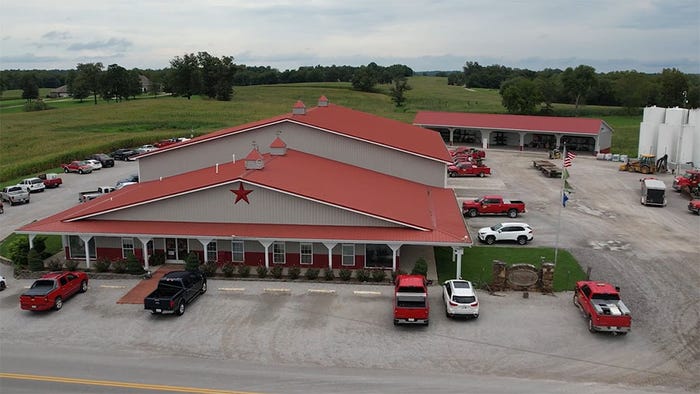
A NEW 40,000-ton dry fertilizer plant standing alongside a unit-train spur in Alton, IA, has allowed its owners to largely avoid this winter's expensive — and highly volatile — fertilizer market.
The fertilizer hub, owned by Northwest Iowa Agronomy, was placed in service in spring 2005 to enable the owner co-ops to participate in the emerging global marketplace for fertilizer, primarily urea. The facility allows the company to purchase trainloads of fertilizer and to stock up on plant nutrients when the market is right.
To say that the timing was right is an understatement.
Late last summer, Northwest Iowa Agronomy, which is owned by four area co-ops, along with Agriliance, purchased the lion's share of the co-ops' fertilizer needs for the fall, as well as for spring 2006.
“We've got most of our fertilizer locked in,” says Ken Ehrp, president of Northwest Iowa Agronomy and manager of one of the owner co-ops. “We purchased most of the three major nutrients right before the hurricanes. We were very fortunate.
“With changes in the marketplace because of imports, the time to purchase fertilizer has changed, and the timing is hard to predict,” he adds. “Now we can buy and store fertilizer at the right time because we have the storage capacity. You have to be able to take advantage of buying opportunities when they are available.”
Granular future
Although there were many reasons to build the plant, being able to buy and store imported urea was an important factor, Ehrp says. Urea is expected to become the dominant nitrogen form in the U.S. as globalization and high domestic natural gas costs squeeze production of domestic anhydrous ammonia.
The importance of the global marketplace for nitrogen fertilizer — and the reason granular urea has a strong future in the U.S. — is underlined by the fact that, in 2004, 55% of U.S. nitrogen was imported, up from 40% just a few years ago, says Bruce Vernon, Agriliance director of crop nutrients marketing. That percentage is expected to continue to grow as global competition continues to put the squeeze on domestically produced nitrogen.
This winter's high-priced and highly volatile energy and anhydrous ammonia market is expected to escalate the trend.
“I think this will push the market toward urea,” Vernon says. “Urea is up, but not as much as ammonia.” Spot anhydrous ammonia shortages expected by some this spring will further drive the trend, he adds.
Most nitrogen imports are in the form of granular urea, which is the imported nitrogen form of choice because it is relatively inexpensive to store and ship compared to ammonia, a pressurized gas and a hazardous material. Liquid urea ammonium nitrate (UAN) isn't competitive because of the higher cost of shipping the lower-load liquid.
“I think this trend [toward more imports] will continue,” Vernon says. “We will not lose all the domestic manufacturing, but there are an awful lot of plants under construction across the world that will put product into the global market — and put continued pressure on domestic manufacturing.”
As imports have become more important, Agriliance has seen anhydrous ammonia volume decline 3 to 8% per year over the past seven years. However, anhydrous ammonia won't disappear, given customer preferences and the existing manufacturing and support infrastructure.
U.S. anhydrous ammonia production statistics sketch a bleak picture of what has happened the past half-dozen years. In the late 1990s, U.S. anhydrous ammonia production peaked at 18 million short tons, points out Mike Rahm, vice president for economic and market analysis for The Mosaic Company, which was formed in 2004 by the merger between Cargill Crop Nutrition and IMC Global.
“We now project that U.S. gross ammonia production will drop to less than nine million tons for the fertilizer year ending June 30, 2006, so we have seen production shrink by about one half,” he says.
Energy-intensive blues
The shift to an import-dominated nitrogen market is borne out of natural gas price shocks earlier this decade. Because energy makes up about 85% of the cost of manufacturing nitrogen fertilizer, the impact of these price shocks was huge for both manufacturers and their customers.
Before 2000, the price of natural gas in the U.S. was relatively stable at about $2/mmBtu (million British thermal units). Since then, the price has trended sharply upward and become extremely volatile, with winter gas trading in the $11 to $15/mmBtu range in December 2005.
“Record-high U.S. natural gas prices are accelerating the transition of the global nitrogen market,” Rahm says. “Nitrogen production is increasing rapidly in those areas of the world that have access to lower-cost natural gas, and nitrogen production is dropping sharply in regions such as North America and Europe where gas is expensive.”
When natural gas prices shot up, investment was made in new nitrogen fertilizer plants in the Middle East and the Caribbean, where natural gas costs $1 to $2/mmBtu. Those plants are coming online to supply the U.S. as well as the growing world market for fertilizer.
A look at the core economics of producing urea fertilizer highlights the challenge for domestic nitrogen producers. Manufacturing a ton of urea fertilizer requires about 23 mmBtu of natural gas. With a price spread of $5/mmBtu between U.S. and Middle Eastern gas, nitrogen manufactured there has a $115/ton price advantage, minus roughly $35/ton to ship to the Gulf of Mexico, Rahm says.
The impact of these economic realities will gradually eat away at the domestic nitrogen industry, Rahm and others say.
“If U.S. gas prices continue to trade at $5 to $10/mmBtu more than gas in other parts of the world, imports could climb to 75% or more of use in just a few years,” Rahm says.
Price scenarios
Fertilizer industry experts expect the shift toward more nitrogen imports to develop in waves. These waves will occur as new manufacturing plants in inexpensive natural gas markets come online. As this occurs, supply could outstrip demand at times, resulting in price declines, says Richard Downey of Agrium, the large Canada-based fertilizer manufacturing and agricultural retailing company.
He expects that, over the next three years, world nitrogen prices will remain volatile and near the historically high levels experienced over the past year. Although new plants will be coming online, growing world nitrogen demand, which increases 2 to 3% annually, will offset higher manufacturing capacity in the short term.
However, around the end of the decade, when plants currently in the planning stages have been built, supply could exceed demand, resulting in lower nitrogen prices.
“Eventually, we will get into an oversupply situation,” Downey says. “Right now, good money is being made on nitrogen, so plants will be built. We are likely to see a rash of plants being built in the 2009 to 2010 period.”
That will be good news for nitrogen fertilizer buyers and bad news for nitrogen manufacturers with a high cost of production. “The high-cost producers in Western Europe and the U.S. will lose,” Downey says.
“We could easily see prices 20 to 30% lower than last summer's prices toward the end of the decade,” he says. “We may never see nitrogen prices in the 1998 to 2002 range again, but we are likely to see prices decline to a lower longer-term average.”
The U.S. still is the fourth largest nitrogen producer in the world, even after the sharp decline in output this decade. One of the consequences is that U.S. natural gas sets a floor for world nitrogen prices, adds Rahm of the Mosaic Company.
“As new capacity comes on, there will be a period when world values will drop below that floor,” he says. “That will set in motion another round of closures. Then you are right back in the soup and U.S. gas values will again set the floor.”
Some U.S. nitrogen producers are planning for this challenging future by going offshore or by switching production to formulations such as UAN, whose high transportation costs can make domestic production more viable compared to imports. Terra and CF Industries reportedly are exploring building production facilities in Trinidad.
Not the only game
Although urea is likely to continue to be the biggest player in the global nitrogen marketplace, other nitrogen forms also will be imported.
“It is not just a urea game,” Rahm says. “We also may see more ammonia imports. There is an efficient, well-developed infrastructure, including pipelines, that is likely to continue to be utilized.”
UAN imports may also rise. Rahm notes that the government of Trinidad, which controls large offshore gas reserves, is interested in producing UAN because it further processes ammonia and requires a larger local workforce than granular urea. “The players down there see the U.S. as a 10-million-ton UAN market,” he says.
Environmental protectors
Agricultural businesses and individuals must project a positive image by promoting environmental stewardship of the crop protection industry to receive
The "git 'r done" approach
Git 'r done. Anyone who has watched the Blue Collar Comedy Tour knows the phrase has been a good one for Larry the Cable Guy. It might be just as good
Computers don't get tired
The sole purpose of Tri-State LLC, located in Fairmount, ND, is to supply either raw or blended fertilizer for other retailers. For that reason, it has
Nurse tank plates
THE ILLINOIS Fertilizer & Chemical Association recently posted an important reminder to ag dealers on its Web site. Nurse tanks for carrying anhydrous
Strip-till's profit boost
AG RETAIL businesses wanting to expand sales should investigate new ways to help current customers become more profitable, says Dan Towery, ag consultant,
Fertilizer outlook
HIGH ENERGY prices that put the fertilizer market in the doldrums this fall and winter could result in spot shortages of nitrogen and phosphate fertilizers
Friends of the environment
THE DECISION to invest in new storage and handling facilities in the last few years has reaped rewards for Eastern Farmers Co-op and Farmers Elevator
New mix for pop-ups
FMC CORPORATION has developed a new formulation of its Capture insecticide for corn that has better mixing properties than emulsifiable concentrates (EC)
Price predictions
THIS GROWING season there is good news about nitrogen fertilizer: It appears that prices for the fertilizer will fall in late spring and early summer
Just-in-time fertilizer
THE TIME when fertilizer dealers will be able to reliably supply customers who want to book fertilizer just before they need it is coming to an end. Dealers,
Prevent rust in nurse tanks
IF YOU test your company's nurse tanks, remember to put ammonia back into the tanks as soon as possible to prevent the inside of the tank from rusting,
Energy anxiety
AFTER HURRICANE Katrina battered the Gulf States in August of last year and inflated the nation's energy-related prices, some ag retailers were caught
4 risks in buying fertilizer
PERHAPS THE biggest lesson learned by the agricultural supply industry in the past year is that the business environment is riskier than ever, especially
Smart nitrogen advances
If David Hodges' experience with marketing Agrium's ESN (Environmentally Smart Nitrogen) fertilizer in 2006 is any indication, sales of the polymer-coated
Volatile product
Michigan is one of only six states to have passed legislation that regulates the use of ammonium nitrate, an important nitrogen (N) fertilizer used to
Thwart meth makers
Some 10.4 million Americans age 12 or older have used methamphetamine (meth) at least once in their lifetimes
Crop Sensor: Q & A
VIACHESLAV (SLAVA) Adamchuk is one of several U.S. land-grant researchers currently investigating innovative ways to use sensor technology for precision agriculture
Assessment tool
The Illinois Fertilizer and Chemical Association (IFCA) has a good tool to help ag retailers ensure that they are complying with regulatory requirements
License plate enforcement
The state of Illinois recently announced that it will more uniformly enforce the requirement for fertilizer wagons to have license plates
STEP up to stewardship
The Mid America CropLife Association (MACA) recently recognized three ag retailers that have gone above and beyond the requirements of their state and federal laws to ensure good stewardship in their communities
Fall fertilizer forecast
Fertilizer Management has become more of a year-round responsibility than it used to be, says Gayle Melcher, manager of Clarinda Co-op Company, Clarinda,
Healthy beans
ANOTHER soybean processor has joined the list of companies that plan to contract for Monsanto's Vistive low-linolenic soybeans. CHS announced it will
Old habits die hard
YOUR GROWERS' crop rotation has most likely changed over the years, but their lime applications may not reflect that change. Some Midwestern researchers
Tougher beans
STEVE HENRY, who farms near Nevada, IA, is trying to learn everything he can about Sudden Death Syndrome (SDS). However, he's frustrated with the lack
Scout for western bean cutworm
WESTERN BEAN cutworms (WBCs) have been a problem in the western Corn Belt since the 1940s and last year were discovered to have migrated further east
Price hike for services
FIGURES FROM the Department of Energy's Energy Information Administration (EIA) indicate that between the last week of February 2005 and the last week
Highway safety reminder
DURING THE spring application season, it is important to remember highway safety and to ensure your employees have received up-to-date training on the
Environmental edge
SOME AG retail businesses have found a lucrative new enterprise in an unlikely source: manure. Take the Farmers Cooperative Society (FCS), Sioux Center,
The Phosphorus Index
NEW EPA and USDA efforts to improve surface water quality throughout the nation emphasize keeping a close eye on phosphorus (P), says Antonio Mallarino,
Valued partners
In the last few years, distributors of crop inputs have seen their role evolve from warehouse and transportation managers to providers of information
A fresh approach
We need to look from the outside in to step back and reassess how we are conducting business, says retailer Tim Sanders of the DeLong Company, Clinton,
Swift action
Timing is the name of the game in treating Asian soybean rust. That message was sounded loud and clear by researchers and company executives at the recent
Be prepared
If the prospect of Asian soybean rust (ASR) hasn't already given you a scare, keeping track of the treatment options could add to the fright. A dozen
Learning the lessons
When you've had the chance to visit with farmers, ag retailers, and farm managers for more than 30 years, there's one thing you learn right away about
Value and profits
Although retailers across the country specialize in helping growers produce a wide variety of crops from rice to soybeans to peppers, retailers have one
Complaint control
UNCOOPERATIVE WEATHER patterns in much of the Corn Belt kept many ag retailers and applicators working overtime to keep pace with farmer demands this
Service-selling tips
WHEN SELLING to a customer, you must illustrate value, and to keep a customer, you must prove value over time, says John Wagner, president of AgRePlan
One up on Wal-Mart
AN IMPORTANT part of the success of Wal-Mart, the world's largest retailer, is attributed to its sophisticated inventory management systems. In the world
More E85 at the pump
CHS ANNOUNCES it will provide a Cenex-branded E85 fuel to 22 terminals in Colorado, Iowa, Illinois, Kansas, Minnesota, North Dakota, Nebraska and South
Contract savvy
As more products with valuable output traits come out of the crop technology pipeline, so, too, should come new opportunities for ag retailers and growers.
Low impact?
U.S. SOYBEAN producers, bombarded almost daily with reports of new discoveries of Asian soybean rust, may be wondering at what point new findings of the
Urban opportunities
URBANIZATION HAS contributed to the demise of some ag retail operations. But for retailers able to adapt to the changing landscape, it has opened new
3 ideas to help you keep customers
THESE DAYS it's extra challenging to satisfy and keep customers, says Nancy Friedman, president, Telephone Doctor, St. Louis, MO, an international customer
Complete systems
THE WORD may cause some ag retailers to cringe, but not Rod Miller, seed systems manager for Crop Fertility Specialists (CFS), Rossville, IN. Miller says
Wireless grain
COMMODITY Resource Corporation (CRC) based in Caledonia, NY, is one of a growing number of operations that are working to bring bulk commodity handling
Invaluable service
WHY SHOULD ag retailers sell services? The resulting customer interaction is invaluable and helps create long-term ties that are difficult for competitors
Dry run
IN 2005, agricultural retailers confronted grower fears, procured adequate fungicide supplies and developed plans for rapid application, all for a disease
Treat seeds for success
SINCE THE INTRODUCTION of genetically modified herbicide-tolerant and insect-resistant traits in corn and soybeans, ag retailers have seen a huge shift
4 ideas for coping with ASR
WORK HARD to manage growers' expectations about Asian soybean rust (ASR), advises Duane Mol, chemical manager for Crop Production Services, Galesburg,
Court good customers
WHAT'S THE best way to keep good customers coming back and to attract new ones? Fix annoying problems The first step is to focus on frustrations, says
To expand or not to expand
EXPANSION THROUGH merger or acquisition has been taking place in the ag retail industry for some time now. Some mergers and acquisitions have gone relatively
Atrazine adjustments
FOR GROWERS concerned with using atrazine to control weeds on sensitive watersheds, management alternatives are plentiful, says Bill Johnson, Purdue University
Optimal application
NOT EVERY expert agrees on how best to boost a sprayer's effectiveness, but few would disagree that the ultimate objective of a crop protection application
Variable-rate review
GLOBAL POSITIONING systems (GPS) and variable-rate technology (VRT) have been available to ag retailers and their farmer-customers for more than a decade
Invaluable service
WHY SHOULD ag retailers sell services? The resulting customer interaction is invaluable and helps create long-term ties that are difficult for competitors
Natural disaster preparation
LAST YEAR'S hurricanes and flooding made many stop and think about what they would do if they, too, were hit by such a natural disaster. Not long after
Less chemistry, more biotechnology
BY NOW, it's no surprise to most agricultural retailers that few new herbicides are entering the corn and soybean marketplace. Because new product development
Cherry-picked software solutions
WHEN MIDLAND Co-op Inc. and Impact Cooperative Inc. became partners in 2002, the partnership, called Midland-Impact LLP, faced the challenge of integrating
State-of-the-art facility
SYNGENTA SEEDS recently celebrated renovations to its Phillips, NE, corn production facility. The $4.7 million project increases the plant's seed-conditioning
The adjuvant advantage
MORE THAN 4,000 adjuvants are on the market today to help improve a herbicide's performance. Bryan Young, associate professor of weed science at Southern
Ways to manage health-care costs
AS INSURANCE rates have risen over the last few years, ag retailers have looked for more cost-effective ways to offer high-quality benefits for their
Looking to lenders
CROP INPUT financing programs have become as competitive as the products themselves, and all signs point to a continuation of this trend. The crop input
Too reliant on Roundup?
RYEGRASS AND marestail were the first two weeds to develop resistance to glyphosate, such as Roundup and Touchdown herbicides, but they won't likely be
First-class delivery
SPRAYER AIR technologies have been around for more than 20 years, but until recently, retailers and growers didn't use them much. That has changed, due
Memorable field days
FIELD DAY season rolls around again in just a few months. Farmers will attend, knowing they will more than likely get a good meal and a seed cap. But
Soybean rust Is this the year?
AT THIS time a year ago, retailers were scurrying to stock up on fungicides to quell panic among soybean growers about Asian soybean rust (ASR) and finalizing
Grain storage spillover
LIKE MANY grain-handling businesses, Buckingham Cooperative, near Waterloo, IA, needed to react quickly last year to find enough storage space to accommodate
Seed trackers
THE MANY new combinations of traits and seed-applied insecticides have quickly multiplied the number of seed choices available to growers. Although most
Nourishing the bottom line
Offering nutrient management services requires a fair amount of investment whether it be in additional staff, training, specific software or simply more
21 days and counting
It generally takes 21 days for a certain behavior to become a habit, says Colleen Francis, president of Engage Selling Solutions, a sales training company
Covering new ground
Venturing into new markets can have its ups and downs. Some ag retailers have successfully added lawn and garden or hobby farmer product lines, for example
FROM THE TOP
Are you pleased with the acceptance of ESN Smart Nitrogen, and how does that new product fit with retailers and their relationships with their customers?
FROM THE TOP
Tell us about your experience with Syngenta Crop Protection in Latin America and what that experience will mean to your new position here in North America.
Soybean rust confirmed in Georgia
The USDA recently announced that Asian soybean rust has been identified in Seminole County, GA, on volunteer soybeans. This is the first confirmed U.S.
PRODUCTS
New fertilizer grades Honeywell has launched two new grades of Sulf-N ammonium sulfate (21-0-0-24S) and improved quality specifications and supply for
Pollen blocker
HOEGEMEYER HYBRIDS, a regional seed company based in Hooper, NE, appears to have found a way to prevent cross contamination of pollen from genetically
New grass herbicide
SYNGENTA Crop Protection anticipates that its new postemergence grass herbicide Axial will be approved for U.S. and Canadian registration and sale later
Nematode knowledge
A NEW online course about cotton nematodes is now available from Syngenta Crop Protection and offers certified crop advisors one continuing education
Company merger
CROMPTON Corporation and Great Lakes Chemical Corporation recently completed an all-stock merger to create Chemtura Corporation, the fourth largest publicly
Stay ahead of your customers
WITH THE fast pace of change nowadays, identifying your customers' needs may seem like trying to hit a target moving at the speed of a Japanese bullet
Unlimited calling
THE CHATTER Bug is about the size of a computer mouse, but it has the power to provide unlimited long-distance calling in the U.S. and Canada for $9.95
Cover-All offers hybrid
COVER-ALL Building Systems introduces a new building with a clean exterior design, unique shape and low roof line. Called the Meridian Building, the new
Shipping paper and label changes
NEW DEVELOPMENTS in the harmonization of international standards will change some of the shipping and label designations to which ag retailers have been
Recycling adds up
0 Cost to grower, dealer or custom applicator, in most areas 3 Rinses per container for triple-rinse 4 Recycling contractors serving the ACRC across the
More ethanol plants
New Cargill subsidiary Emerald Renewable Energy LLC has announced plans to develop four ethanol plants in the Midwest and is considering several potential
4 issues affecting rail shipments
The Fertilizer Institute (TFI) has been working with the federal government, individual railroads, the Association of American Railroads (AAR) and others