AmericanCowman.com: Timely, practical production and management strategies that will add efficiency, value, and profitability to cattle herds with up to 100 head.


    Home  

    Market Research  

    For Advertisers  

    Rent Our Lists  

    About Us/Contact Us  

2005 Corn Weed Control Guide

Weeds (select up to 3)


Application Time

Sponsored by
Syngenta Crop Protection


2005 Soybean Weed Control Guide

Weeds (select up to 4)


Application Time

Sponsored by
UPI


Changing with the world

Mar 15, 2001 12:00 PM, Barb Baylor Anderson

A generation ago, agricultural suppliers would have been hard-pressed to look into the future and see a global economy triggered by such revolutionary changes as electronic commerce, biotechnology and digital systems. But those very changes are now encouraging suppliers in a shrinking industry to look beyond traditional business practices to find new, innovative ways to get ahead of or least stay even with the competition. Here are profiles of some of the trailblazers who ventured into new areas of growth in the past year.


Elkhart Grain Company

Three years ago, Don Ludwig was excited about the potential for specialty corn markets. The manager of privately owned Elkhart Grain Company, Elkhart, IL, was aggressively exploring identity-preserved (IP) contracting opportunities for the elevator and its customers.

Today, Ludwig is still interested in IP sales, but he is less optimistic about profiting from quality traits. He added bins last year not to segregate crops, but to take advantage of the carry in the commodity corn market.

“The added storage provides more flexibility and allows us to take advantage of wide spreads,” says Ludwig. “We can handle commodity corn and make money from it, but we also have the ability to segregate corn if we want to.”

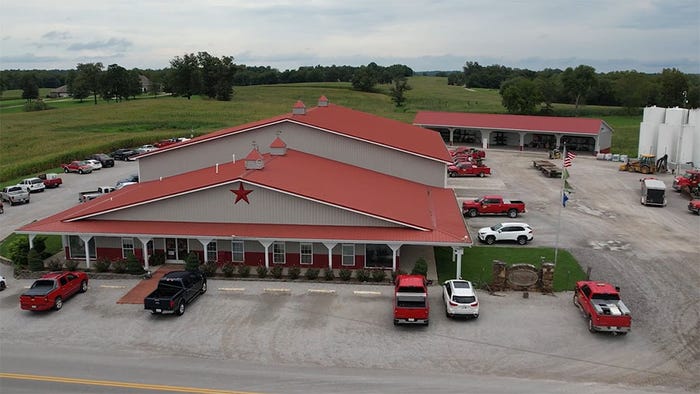
Elkhart Grain Company is located on the Union Pacific Railroad, can be seen from a major interstate and is less than an hour from both the Illinois River and major soybean processors. With more than 70 bins, including traditional concrete tanks and new steel tanks, five dump pits, a track scale and bulk-weigh capabilities, the facility can accommodate deliveries of both commodity and specialty grains.

But when it comes to IP grain, Ludwig says more time is required to coordinate a buyer for such crops, contract the needed acres and devise Plan B in case Nature interferes with the contract terms. Moreover, crop quality, both in the field and in the bins, must be carefully monitored and maintained.

“We got into the IP market early, realized the cost quickly and found it is tough to manage the risk,” says Ludwig. “While we are still interested in the markets, there is less premium to work with now. So many farmers have gotten into IP markets that there are fewer premiums for growers and a smaller margin for handlers that doesn't cover the added expense. We are still contracting for markets and will grow that volume if we can, but the jury is still out on whether specialty grains are the way to go.”

Ludwig is banking on a solid commodity corn market to give Elkhart Grain a base from which to evaluate other opportunities. “Commodity corn is profitable. Specialty grains require more flexibility and foresight,” he says. “But it is nice to know that we can handle crops with a chain of custody and have a history on each field and surrounding fields if or when that information is required by buyers.”


Bottineau Farmers Elevator

“Digital” will define business at Bottineau Farmers Elevator, Bottineau, ND, in the new millennium. The elevator — a locally owned affiliate of Cenex Harvest States established in 1939 — is now a full-service cooperative, providing grain marketing, agronomic services, seed, feed and other support products and activities.

“We are looking for ways to do business that will keep us on the cutting edge of technology and allow us to be seen by our customers and potential customers as an industry leader,” says Gene Erpelding, general manager. “Our customers are intrigued with the potential of electronic commerce, and this may be one new service that we can provide to encourage them to stick with us.”

To that end, Bottineau Farmers Elevator established its own Web site two years ago as a prelude to setting up a storefront to offer services through Rooster.com. Rooster's eBusiness Centers platform will be transactional later this year.

“The goal is to get an information system in place,” says Erpelding. “Rooster will allow us to segment our business like never before and profile our customers so that we can serve their needs more specifically.”

Erpelding has taken strides to install digital communications capabilities to cut down on the elevator's paperwork and streamline operations. He plans to maintain electronic records on his customers so that statements can be e-mailed rather than mailed, for example. Erpelding is also looking at new ways that elevator personnel can communicate with customers via interactive equipment. “We are experimenting with ways to enhance our custom work with digital technology,” says Erpelding. “For example, we may have equipment that reads soils and relays the information back to the office or collects video clips for scouting purposes. We could also have instances where a customer will call in an order that we can send electronically to a floater, which then can make the product application and send the information back to the office so a bill can be immediately generated. Having that capability will make our business run much easier.”

Erpelding prefers to be on the cutting edge not only because of stiff competition for farmer dollars in the region, but also because the technology improves the company's ability to deliver services to a diverse customer base. Bottineau Farmers Elevator works with small specialty producers as well as very large farms. Customers include both traditional operators and innovative farmers. In addition, some 12 different crops must be serviced.

“We are in an area with a lot of IP crops, so putting in place a computer trail from the time seed is purchased for IP production to the time the crop is marketed will only enhance the crop's value,” he says.

Erpelding anticipates that farmers in his region will embrace digital technology. “Ninety percent of the farmers here live in town and have the ability to go digital, so we anticipate good buy-in from customers,” he says. “That will give us a leg up on the competition and allow better two-way communication with most of our customers.

“Digital is the way this industry is headed,” he maintains. “We will have to let some of the kinks sort themselves out, but I am optimistic that farmers will adapt quickly.”


Tama-Benton Cooperative

New pricing opportunities are helping Tama-Benton Cooperative satisfy customer preference for easy marketing strategies as well as increasing the cooperative's potential to add new customers and increase grain flow. The co-op at Dysart and Vinton, IA, added e-markets.com's Decision Rules for Contracts (DRC) pricing option before harvest last year.

Now several months into the relationship, Tama-Benton grain merchandiser Jennie Anderson says DRC has proved its value in meeting customer needs, and the pricing tool is not currently offered by other area merchandisers.

“Most of our customers want pricing tools that are not complicated. Our demographics are such that many older producers in this area prefer to price grain at a certain time of the year,” she says. “E-markets makes it easy.”

DRC pricing strategies allow elevators to work with growers in building a grain marketing portfolio that automates pricing at the e-markets site according to the grower's desired level of risk. Five pricing models are available to elevators and their customers and can be tailored to individual needs. For example, the Market Index Forward model is a conservative approach that prices a set amount of grain every day, regardless of the market price pattern. At the other end of the risk-tolerance spectrum, the Market Prospector model allows producers to set parameters that price larger amounts of grain during rallies. Reports are generated on each product for each customer and can be tailored to mesh with the elevator's recordkeeping needs.

“Some producers expressed reservations at first about the Internet, especially about privacy issues, but they are adapting,” says Anderson. The co-op now boasts a Web site at www.tamabentoncoop.com. “Last fall, some producers gained 10 to 15 cents more per bushel than harvest cash sales. Others did not see much price enhancement because of basis. But we have come a long way from the mentality 15 years ago of ‘I need the money, it must be time to sell the crop.’”

Adding DRC pricing options appears to be a good move for the co-op. “We have not advertised the program, just discussed it one-on-one with farmers,” Anderson says. “Already we have generated some new interest in about a 50-mile radius because some of the competing pricing products available at other locations are drawing some criticism.”

Not everyone who has tried DRC is comfortable with the product, Anderson says, but most producers and the co-op have found sound merchandising opportunities. “We have lost some hedging capabilities from losing basis gains, but overall we have not found any reason not to offer DRC,” she says. “We will recover some income in new sales. E-markets is simple and provides a good paper trail.”


Root Spraying Services

Top-of-the-line equipment, flexible work hours and the addition of bulk tanks give Shane Root, Root Spraying Services Inc., Dighton, KS, a competitive edge when it comes to serving farmers looking for reputability and efficiency.

“I am basically a one-man operation covering a large area in Kansas,” he says. From his Dighton location, Root sprays as far south as Kismet near the Oklahoma border, northeast of Brownell in west-central Kansas, and west of Leoti, not far from the Colorado border. “Word of mouth has increased my business each year, which requires me to improve efficiency to stay competitive and expand.”

Root started out as just an aerial sprayer, then added pickup sprayers and a floater and recently a GVM Rowcat.

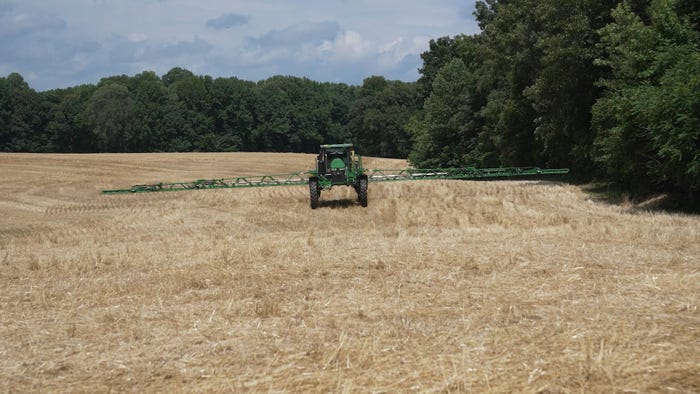
“The Rowcat enables me to cover 120 to 160 acres per hour. It has Satloc MapStar software, which also allows me to operate at night,” he says, adding that he originally purchased the Rowcat because of its high clearance and ability to control dust. “Wind is a problem, so most of the work I do between March and May is at night. Some years I do 79 percent of business between 6:00 p.m. and 6:00 a.m. because I get good reviews on performance when the plants are cool and open up to take the product.”

To further improve his ability to cover such a wide area efficiently last year, Root added four bulk tanks. “Now I don't have to work as hard,” he quips. “I am moving such a large volume of product that working out of shuttles became inefficient. It was a big expense for us to add bulk tanks, but we can compete now with area distributors.”

Root says the competition for chemical spraying business is so high in the area that some farmers are less concerned about quality than they are about price. “You have to be the cheapest or enough better than the competition if you want to get the business,” he says. “Some businesses will sell chemical below cost to bring in the business and make their margins on something else. We believe that the machinery we use is the best all around, and word of mouth about our night work will keep us competitive in the long run.”


Get Copyright ClearanceWant to use this article? Click here for options!
© 2007 Penton Media, Inc.


SEFP ATE


Back to Top


Key:    Paid Content      Enhanced for the Web

Contact Us  For Advertisers  For Search Partners  Privacy Policy  Subscribe
© 2007 Penton Media, Inc. All rights reserved.