![]() |
||||
|
|
||||
|
|
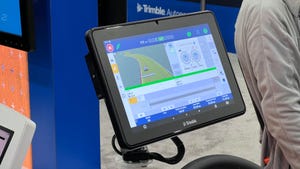
How to choose a GPS lightbar Feb 15, 2003 12:00 PM by Wayne Wenzel With their lower price and easy installation, the new generation of lightbar systems may be a good compromise if you want to drive straighter without making the leap to full autosteer. Thanks to the Wide Area Augmentation System (WAAS), you can now tap into a free GPS satellite signal that's comparable in accuracy to most subscription fee services. As implements get wider and faster, driving straight is an increasingly difficult feat to accomplish without GPS. But with more than 10 different brands of lightbar guidance systems available, which one should you choose? Researchers at Ohio State University recently tested seven lightbar guidance systems to see which drove the straightest lines. Although the researchers wouldn't reveal the brand names of the products tested, they did say accuracy was fairly consistent for most of them, which isn't too surprising, considering that all the systems use WAAS. What's really interesting about the OSU study, though, is what researchers identified as the key accuracy factors to consider when comparing guidance systems. Like a link in a chain, each component determines the overall strength of the total system. Hardware First, the obvious factor — the GPS receiver. It needs to be able to pick up the GPS signal and to be reliable enough to not break down. How long does it take the system to acquire a signal? How often does it lose the signal? Will you be able to get service quickly if it breaks down? Software The next factor to look at is the guidance algorithm. Your unit's speed, reliability and accuracy depend on this mathematical set of instructions. Although you want to start out with something that works and isn't full of bugs, the system should be readily upgradable to the newest guidance algorithm. Most companies upgrade on a regular basis. Some even let you download the latest update off the Internet. Interface The most accurate system in the world will be useless if the display (visual interface) is difficult for you to see and use. The OSU researchers noted that operator response differs with various types of guidance systems. Older operators, for instance, tend to prefer lightbar guidance, whereas younger operators prefer 3-D color guidance systems. Also, operators may prefer different locations for installing the guidance display. Operator Is your driving style closer to that of Mario Andretti or Grandpa Clyde? Driving with a guidance system may let you drive faster, but you've still got to steer. Kids who grew up with video games such as “Night Driver” might think a lightbar on a tractor is a piece of cake. Or they might get overconfident and trade speed for accuracy. Even with a lightbar, driving fast leads to less accuracy. But the more you practice, the straighter you'll be able to drive. Fine tuning The sensitivity setting on the lightbar could significantly change the accuracy of your guidance system. Increasing the sensitivity will improve accuracy, but only to a point. Too much sensitivity will make the lights too jumpy, which increases driver strain. You also need to strike a balance on the DGPS filter setting. In general, using the filter improves guidance accuracy in a straight line but will cause problems in turning and finding the next swath line. Reprinted from Farm Industry News, December 2002. |
|
||||||||||||||||||||||||||||||
| Back to Top |