AmericanCowman.com: Timely, practical production and management strategies that will add efficiency, value, and profitability to cattle herds with up to 100 head.


    Home  

    Market Research  

    For Advertisers  

    Rent Our Lists  

    About Us/Contact Us  

2005 Corn Weed Control Guide

Weeds (select up to 3)


Application Time

Sponsored by
Syngenta Crop Protection


2005 Soybean Weed Control Guide

Weeds (select up to 4)


Application Time

Sponsored by
UPI


         Subscribe in NewsGator Online   Subscribe in Bloglines

Fertilizer sales outlook strong for 2004

Dec 1, 2003 12:00 PM
by Bill Tindall


“One thing we know for sure is that a solid fertility management program is the basis for better yields and improved profits, no matter what the economy,” says Dan Russell, vice-president of North American sales at IMC Global in Lake Forest, IL. Growers know it too, but aren't always willing to put financial resources into crops when income levels aren't as high as they would like to see.

However, in 2004, a number of factors — including higher commodity prices, good availability of fertilizer products, and growers' awareness of the benefits of fertilizer application — should increase the number of fertilizer applications.

Commodity prices

Russell anticipates some improvement in commodity prices in 2004. He predicts '04 soybean prices to show a significant increase to approximately $7.00/bu., compared with $5.50/bu. for '03. He sees average corn prices for 2004 to be nearly unchanged compared with the 2003 level of $2.30/bu. Wheat prices are expected to be slightly lower than the '03 level of $3.56/bu.

Situations throughout the world may increase sales of U.S. commodities. Russell says that China may be a key factor in the outlook for grain prices this year because its grain stocks have fallen to extremely low levels.

Demand for edible oils is increasing in many countries, especially China. “That is creating a very strong global demand for soybeans,” explains David Delaney, president of PCS (PotashCorp) Sales, headquartered in Northbrook, IL. “This is expected to increase U.S. plantings of this crop next spring, with farmers likely to move some acres from corn and wheat into soybeans.”

Expectations are for approximately 78.5 million acres of corn, 61 million acres of wheat and 74.7 million acres of soybeans. Delaney recommends keeping a close eye on how quickly China's once-massive grain inventories approach the floor. He says, “If China does need to import corn in 2004, some of the projected U.S. soybean acreages expected could swing back into corn.”

Strong markets for cotton also are expected to increase cotton plantings by close to a million acres with about 14.5 million acres seeded.

Spring fertilizer prices

What can we expect for spring prices? John Yokley, senior vice president of marketing and distribution at Agrium, headquartered in Calgary, Alberta, says that natural gas can account for up to 90% of the cash cost of manufacturing ammonia, the basic building block for all nitrogen products. “High and volatile natural gas prices in North America since mid-2000 have put much of the North American nitrogen industry under stress,” he says. Fortunately, Agrium has about 40% of its nitrogen production in low-cost gas regions of the world, specifically Alaska and Argentina, with the balance of its production in Alberta, which enjoys a discount to NYMEX gas prices.

According to other fertilizer manufacturers, spot and future prices for gas have been moving upward recently, in the $4.00 to $5.00 range, which is substantially higher than the $2.25 level that producers were paying during the first quarter of 2001.

PotashCorp's Delaney is also concerned with the costs of raw materials. “While natural gas costs seem to be stabilizing at a higher level than we saw a few years ago, they continue to drive up nitrogen prices,” he says. He adds that futures prices for gas suggest that this isn't likely to change in the foreseeable future.

The higher nitrogen prices are also affecting the cost of ammonia used in production of DAP, MAP and polyphosphates. A strong global demand for sulfur is also resulting in higher costs for this major input. At the same time, Delaney suggests that we have too much phosphate product chasing too little global demand. As a result, producers are operating with negative margins. “This could lead to further curtailments,” he says.

In potash, the softening of the U.S. dollar means margins for producing potash fertilizer are being squeezed. Its input costs such as labor, gas and maintenance materials are in Canadian dollars along with other costs such as taxes, though the product is sold in U.S. dollars. “Tighter demand for potash is currently supporting a firming of the potash market,” Delaney concludes.

IMC Global's Russell says that a single phrase captures the company's projections for input costs — they are expected to remain firm. He, too, says that natural gas prices are likely to keep ammonia prices high for manufacturers. Russell notes that potash prices have moved up $6.00 to $8.00/ton since July 2003. “For spring 2004, prices should stay steady, but we could see a slight increase prior to the spring application season,” he says. “Nitrogen prices are expected to stay high for the near term, driven primarily by heavy plantings in '03, good fall demand, and high natural gas prices through the year.”

John Malinowski, senior director of sales and marketing at J.R. Simplot, Boise, ID, echoes much of this sentiment. “Costs, especially of raw materials, are up significantly for nitrogen and phosphate products,” he says. However, Simplot's initial indications, based on the fall season, are that nutrient application rates in many areas are up compared with the past two or three years.

“The main reason for this is probably related to lower soil available nutrients in these areas,” Malinowski says. Regardless of the reason, a strong fall application season generally bodes well for both basic manufacturers and retailers as an indicator for a good overall fertilizer year.

Demand

Fertilizer demand throughout the fall has been good. At IMC Global, demand for potash has remained steady, or at near record sales, during the July through September period. “A number of things have contributed to this,” Russell says. “There has been an improvement in commodity prices, low producer inventories and some grain-driven transportation shortages. Of course, a good harvest can have a significant impact on fertilizer sales, so this year's sizeable corn harvest has also been a major factor.” He adds that IMC Global continues to work with and encourage dealers to help their growers practice good fertility management. “We feel that is crucial for improving demand for dealers and for increasing profit opportunities for the customers,” he says.

Delaney expresses calculated optimism regarding better conditions this year. As a basis for this optimism, he refers to a 2001 Potash and Phosphate Institute summary of data for potash and phosphate nutrient levels taken from 2.5 million soil samples collected across North America. That study found that, in close to half the fields, farmers would see a crop yield response from increased applications of phosphate and potash. He explains, “Farmers have been very cautious with their fertilizer application rates recently, but they are smart business people.”

Delaney thinks that farmers' awareness of the growing need for crop commodities, an anticipation of higher prices, and a U.S. Farm Bill that offers growers a reasonable measure of income stability will lead them to increase the number of fertilizer applications, resulting in better yields and a higher income. “That's good news for retailers and should cause applications to be up from last year,” Delaney says.

Transportation

J.R. Simplot's Malinowski suggests that the strong fall application season will take a bit of pressure off logistics. “If we continue with the good progress we are making this fall, it is quite likely that the percentage of product that has to move through the compressed spring application season will be reduced, hence less logistical pressures,” he says.

Other fertilizer manufacturers, such as Agrium, have been in the business so long that they are confident spring deliveries will be made on schedule and that retailers and growers will receive the products they need when they are needed. Still others think that rail movement might be slightly impaired due to increased grain movement throughout the fall of 2004.

Education programs

Several programs are available to retailers to help them educate customers about the benefits of adequate fertilizer application. Agrium offers Agrium University, Diagnostic Field Schools, and Technology Days. The company also works closely with The Fertilizer Institute and The Canadian Fertilizer Institute, which has recently launched its Nourishing A Growing World program to fertilizer retailers.

PotashCorp also continues to have a strong agronomy support program. One of its most successful initiatives is a fertilizer information program called Fertile Minds. It was developed to provide everyone connected with the fertilizer industry with the facts and tools they need to set the record straight on the benefits of fertilizer use. “Our growing urban population means that many people are no longer able to see these benefits first-hand and may accept misinformation as fact,” Delaney says. The Fertile Minds program clears up these misconceptions using a simple, straightforward approach. The program can be accessed at www.fertile-minds.org.

IMC Global's Back-to-Basics program continues to offer dealers the tools for teaching growers the basics of soil fertility. Through Back-to-Basics.net, IMC offers dealers and their grower customers a wide array of resources on the importance of soil fertility management. “We know, as do dealers, that no matter what the economic or agronomic environment, farmers need to make the basics of a profitable crop production program a top priority,” Russell emphasizes. “Proper soil fertility is the foundation on which high yields are built. Through mailings, meetings and its Web site, IMC is committed to keeping the proper soil fertility issue at the forefront and in providing the tools to help dealers counsel their grower customers.”

As everyone in the industry knows, solid fertility management is the basis for better yields and improved profits. No matter what the economy, we have to keep that in mind.

Variable-rate application

Technology that improves yield with less nitrogen fertilizer is an antidote to higher fertilizer prices, according to Oklahoma State University (OSU) agronomist Bill Raun.

Raun is a member of OSU's agricultural research station team that has developed a sensor-based variable-rate fertilizer system, which last year won the USDA Secretary's award “as the most revolutionary method for fertilizing crops in a century.”

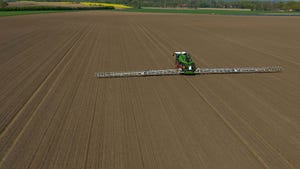
Called GreenSeeker, the system — attached to fertilizer applicator booms — emits and captures infrared and near-infrared beams of light that measure the color and health of crop plants, then delivers, in a fraction of a second, the precise amount of fertilizer needed for maximum yield. The system works equally well day or night when reduced wind drift eliminates overspraying.

“GreenSeeker has been tested in farmer wheat fields with nitrogen use efficiencies improved by more than 20% and farmer revenue increased by $10 to $18 per acre,” Raun says. “In addition to the savings in fertilizer, GreenSeeker, which recognizes and treats each two-foot-square area in farmer fields based on a predicted yield potential, can actually increase cereal grain yields using less nitrogen.”

This technology solution comes at a time when news media are reporting a huge cost burden for farmers as prices for natural gas, an essential element of nitrogen fertilizer production, skyrocket and global supplies remain tight.

The story is the same for all farmers, from corn farmers in Indiana to wheat farmers across the northern Great Plains states and the Prairie Provinces, according to Raun. He states, “Improved nitrogen use efficiencies, now at a world average of just 33%, will significantly decrease environmental risk associated with the use of nutrients in crop production and increase economic profitability to farmers.”

For more information, visit www.greenseeker.com.


SEFP ATE


Back to Top


Key:    Paid Content      Enhanced for the Web

Contact Us  For Advertisers  For Search Partners  Privacy Policy  Subscribe
© 2007 Penton Media, Inc. All rights reserved.