AmericanCowman.com: Timely, practical production and management strategies that will add efficiency, value, and profitability to cattle herds with up to 100 head.


    Home  

    Market Research  

    For Advertisers  

    Rent Our Lists  

    About Us/Contact Us  

2005 Corn Weed Control Guide

Weeds (select up to 3)


Application Time

Sponsored by
Syngenta Crop Protection


2005 Soybean Weed Control Guide

Weeds (select up to 4)


Application Time

Sponsored by
UPI


         Subscribe in NewsGator Online   Subscribe in Bloglines

Glyphosate corn: Generics and overuse are key issues

Feb 1, 2004 12:00 PM
by Natalie Knudsen


For the past several years, nearly 100% of soybean acres have been planted to Roundup Ready technology, but Roundup Ready corn acres lagged behind soybeans, with the USDA reporting just 11% of corn acres planted to Roundup Ready corn in 2003. Today corn growers in many parts of the country are beginning to embrace Roundup Ready corn for its simplicity.

“We're looking at 100% soybean and 100% corn acres planted with Roundup Ready traits,” says Don Holt, branch manager of Midway Co-op in Bellaire, KS. “With that many acres under glyphosate, the combination of name-brand products and generics gives growers the freedom to choose what's important — price or guarantees.”

Products on the scene

The ever-growing glyphosate market provides plenty of sales opportunities. As Monsanto and Syngenta continue adding products, they face competition from a growing number of generics as well.

ClearOut, a generic glyphosate product, was singled out for publicity when Monsanto filed a lawsuit against its manufacturer Chemical Products Technology LLC.

“The lawsuit made a lot of our customers reluctant to try the product,” says Art Assad, president and CEO of Agrisel USA Inc., a ClearOut distributor. “Now that Monsanto and CPT have settled their lawsuits, we expect to see a significant growth in our ClearOut sales for 2004.”

For Assad, one major advantage of ClearOut is its single label for all uses, including agricultural, non-crop turf and forestry. “Our customers do not have to inventory two or three different labeled glyphosates, allowing them to manage their inventory more profitably,” he notes.

ClearOut 41 Plus is a post-patent, independently produced, glyphosate-based treatment composed of 41% glyphosate and fully loaded with 15% surfactant. “Our product is able to offer growers an effective, lower-cost alternative for their glyphosate use,” Assad adds.

Monsanto's Roundup WeatherMax and Syngenta's Touchdown Total glyphosate products offer full-service guarantees for growers, including respray, replant and trait crop loss coverage.

Touchdown Total recently received EPA registration for over-the-top use in glyphosate-tolerant soybeans, cotton and corn, and as a preemergent burndown treatment for both conventional and glyphosate-tolerant crop systems.

Adding to the crowded mix in the market, a number of private label glyphosate products are also offered. “As a retailer we sell private label product because we know it's a quality product,” says Jeff Cleveland, Cenex Harvest States in Corsica, SD. “Buyers have the choice of a higher-priced private label of known quality but without the program guarantees.”

According to Joe Shirbroun, a grower from Farmersburg, IA, the growing generic market is a result of cost issues and value perception with name brands. Updated research from Iowa State University reports that university trials have consistently demonstrated similar performance among glyphosate products when equivalent rates are applied and label recommendations for surfactants are followed.

So how does a grower choose a glyphosate product?

Economics

“Growers are looking at price more than ever this year,” Cleveland says. “Some feel you get what you pay for and others take their rewards as a lower price rather than a guarantee.”

According to Holt, 75% of his customers still rely on Roundup or Touchdown products. “The bigger farmers are playing with price and generics, but the Mom and Pop operations are staying with the name-brand products and guarantees,” he says.

Although Cleveland says some of his growers had control issues with generics last year, Holt says he doesn't see a difference between the generics and the name-brand products when equal amounts of product are applied.

For the retailer, margins are slim and getting slimmer on glyphosate products. Many are trying to capture lost margin by moving more actively into the seed business.

“We've been able to capture a little margin on the seed side,” Cleveland says, “but it gets more competitive every year.”

According to Corey Huck, Touch-down brand manager, Syngenta's new Touchdown Assurance Plan allows retailers to sell or position their agronomic expertise. “It allows them to work closely with their customers on a herbicide plan and help resolve any questions or concerns they might have,” he says.

Holt predicts that, between the loss of margin on glyphosate and loss of custom application acres, within two to five years his business won't be able to afford to sell glyphosate to farmers for their own spray use.

Growers aren't happy just to have lower-cost alternatives on their glyphosate, however. They want to save more money by cutting rates.

Too much of a good thing

According to Assad, glyphosate use can be viewed as an effective farming tool that's providing good weed control, and he expects to see glyphosate use growing at 10 to 15% annually.

“Unfortunately, even with cheaper glyphosate, growers are still cutting rates,” Cleveland says. “They know they're killing everything but some lambsquarter and kochia with their reduced rates but they don't see the importance of killing the weeds completely.” His customers currently apply glyphosate to 99% of their soybeans and 50% of their corn acres.

The ease of use is a primary concern for custom applicators. “Glyphosate is easy for the grower to spray and they feel they can get by without a tankmix such as Harness or even a surfactant,” Cleveland says.

According to David Heering, Roundup technical manager for Monsanto, “Six years of university research with continuous Roundup Ready crops demonstrates the key is to use the right rate at the right time according to labeled directions to obtain maximum performance.”

“We have growers spraying glyphosate four to five times a season instead of using a disk or cultivator,” Holt reports. “They don't even look at the label recommendations.”

From “It's between me and my checkbook,” to “Nobody's going to tell me how to farm,” Holt says he's heard all the excuses when he tries to explain usage recommendations to growers. “Part of the problem is that growers aren't held accountable like a retailer is for label recommendations,” Holt says. “They're able to cut rates, run without tankmixes, ignore refuges and spray a neighbor's field with a farm chemical license without state and federal guidelines applying to them.”

Long-term glyphosate efficacy

“Touchdown Total's label is the first in the industry to contain guidelines for glyphosate-resistance management including application limits for corn, soybeans and cotton,” notes Chuck Foresman, technical business manager for Syngenta. “We believe that growers, dealers and applicators want to do the right things to sustain the efficacy of glyphosate products.”

Despite label recommendations, press releases and product mailings, many growers spray glyphosate at the rates and frequency they need to control their weeds.

Holt predicts that within two to five years glyphosate efficacy will be significantly reduced without the use of tankmixes. “We're seeing some grasses with resistance; it's just a matter of time until it's like the Banvels,” he says.

“Glyphosate resistance has been extremely rare in comparison to other chemical modes of action,” says David Heering at Monsanto. “There are only two weed species in the U.S., and six in the world, that are resistant to glyphosate. In cases where glyphosate resistance has occurred, it has been easily and economically managed.”

“There are a lot of things leading up to the long-term efficacy issue,” Holt points out. “Monsanto and Syngenta should stop worrying about selling product and do something to control farmers. Farmers don't read the press releases.”

“The main point is to use the ‘right rate at the right time’ and remember to use the labeled rate for the most difficult weed to control in your field,” Heering stresses.

Redball ties sprayer rebates to Roundup technology

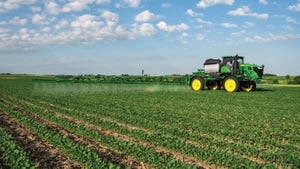
Redball sprayer rebates up to $4,000 are available to growers purchasing Roundup Ready corn. The rebate requires a specified minimum purchase of Roundup Ready corn or YieldGard Corn Borer with Roundup Ready corn (or a combination) in northern states and a minimum purchase of Roundup Ready corn in conjunction with Roundup Ready cotton or Roundup Ready soybeans in southern states.

“We've enjoyed an ongoing relationship with Monsanto on cross promotion of our hooded and direct sprayers in the South for the past 10 years,” says Tom Sanders, U.S. sales manager for Redball LLC, headquartered in Benson, MN. “And we felt that adding the Northern Corn Belt states to the promotion was a way to introduce new customers to our sprayer lineup.”

According to Dave Rhylander, Monsanto's traits leader for the U.S., although Monsanto has offered financial incentives on cross promotion programs in the past, that is not the case today.

“This promotion with Redball sprayers is not our program. Redball is simply associating our technology with their sprayers,” he notes. “There's no financial input on Monsanto's part.”

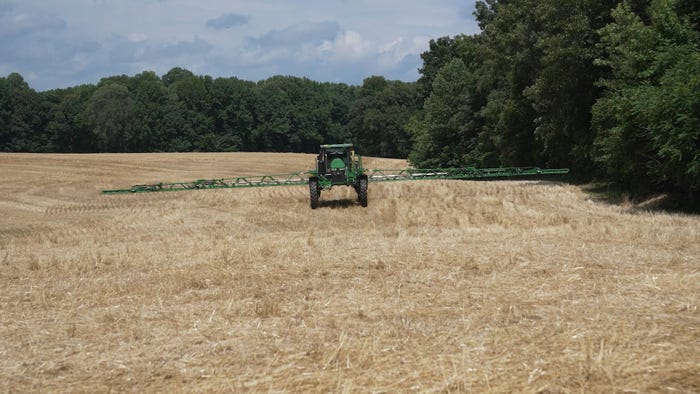
Growers are free to select any company's seed as long as it contains Roundup glyphosate-resistant technology. The sprayers range from 850-gal. units with 60-ft. booms to 2,000-gal. units with 120- to 132-ft. booms. All units purchased through the rebate program will have the Roundup logo.

“Our intent is not to sell to growers on an arbitrary basis and compete with custom applicators,” Sanders stresses. “We want to focus on growers already doing their own application or those having trouble covering all their Roundup Ready corn acres in a timely manner as those acres continue to increase.”

Redball also runs a $5,000 rebate program for custom applicators looking to upgrade their sprayers with larger units.

“Monsanto did give Redball permission to use our brand logo on their equipment for this program,” Rhylander says, “but the program really is about a company using some entrepreneurial spirit and combining their product with a growing technology.”

Editor's Note: Following is a letter sent recently to Apply magazine from Paul Kolterman, 15-year veteran of the crop protection business, first as a retailer, then as a sales representative for American Cyanamid and most recently Syngenta.

Thoughts on our business

I wanted to write concerning something that is a burning passion inside me about our business climate, the industry, and the urgency I feel toward the industry's direction for 2004 and beyond.

I have always had a passion for farmers and helping them do what they do best, better. I got into this business through retail and wholesale fertilizer in 1987. From 1987 to 1991 I was in retail and wholesale fertilizer and chemicals. During the summer of 1988, DuPont called meetings of all retailers and several large growers to discuss a problem they were having controlling weeds in the High Plains. I went to a meeting in Sterling, CO, the purpose of which was to discuss DuPont's decision to voluntarily pull Glean herbicide from the marketplace in the Western High Plains due to weed resistance.

At the time the weeds in question were prickly lettuce, kochia and Russian thistle. I was pretty mad because my retail location had thousands of acres of resistant weeds that we could not control, and it was really due in part, I believed, to poor stewardship of the herbicide in the first place. In only a few short years we could not use the great chemistry from Glean and get weed efficacy anymore.

In 1991 I went to work for American Cyanamid and stayed there until February of 1999. It grew to a $1.1 billion company before things headed south for them. They were an outstanding company to work for and were great marketers.

I feel two things led to the demise of Cyanamid: 1) market devaluation due to the introduction of Roundup Ready (RR) soybeans, and 2) weed resistance due to ALS-resistant waterhemp. In 1997 I had 85% market share in soybeans with Pursuit and Pursuit Plus herbicides in my area, along with 70% market share in soybeans with Prowl. I also had 65% market share with Counter CR in the soil insecticide market for my territory.

Today, Counter CR is being discontinued, and Pursuit and their ALS family market share has dropped to virtually nothing. Cyanamid sales went from $1.1 billion to $875 million to $550 million in a short three years due to the introduction of RR soybeans and weed-resistant waterhemp.

What does this have to do with you? Well, today we are all faced with the challenge of moving the business forward. We are given the daily task of helping our retailers and growers understand the market and agronomic solutions we provide. I feel a real sense of urgency that glyphosate tolerance is THE message our customers need to hear OFTEN.

Also, our retail and wholesale customers are faced with great market devaluation, due to RR technology, and generic pressures on all fronts, from insecticides to herbicides and fungicides. This could be history repeating itself if RR technology is allowed to penetrate the corn market as it did the soybean market!

With RR beans comprising upwards of as high as 95% in some areas, and RR corn approaching 65 to 70% in some areas, especially the Western Corn Belt, we should all remind our growers and retailers of the past. Market devaluation and weed resistance destroyed one company and took literally millions of dollars out of the marketplace for the retailers, distributors and manufacturers.

More importantly, the people who will suffer most will be the American farmers — the people all of this technology was supposed to help in the first place.

So, when sales reps from any company walk into the retail partners' office and visit with the farmer/customers, talk to them with a sense of urgency about why market devaluation should be of utmost concern to them. Visit with them about why generics destroy value, margins and profitability. Visit with them about weed resistance and what it truly means to our business, their business, and for our farmer/customers over the long haul.

Let's get the message out that RR technology is a tool to be used responsibly, with great stewardship, and that market devaluation and generics are truly a harmful thing to the American farmer.


SEFP ATE


Back to Top


Key:    Paid Content      Enhanced for the Web

Contact Us  For Advertisers  For Search Partners  Privacy Policy  Subscribe
© 2007 Penton Media, Inc. All rights reserved.