![]() |
||||
|
|
||||
|
|
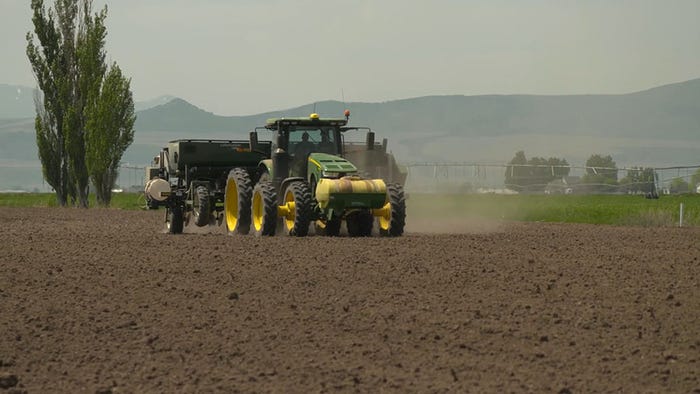
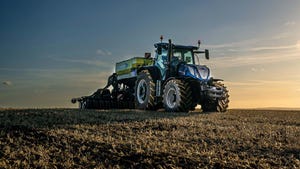
Help Wanted Jan 1, 2003 12:00 PM, Ron Ross Although it began on a tragic note, today the unusual alliance between West Central Cooperative and Boone, IA, farmer Larry Stolte is making good business sense. A plane crash two years ago took the life of a local custom applicator, creating a need for someone to carry on a strip-tillage, zone-banding fertilizer service that the applicator shared with the co-op. Stolte fit the bill. Five years of positive experience strip-tilling soybean stubble going to corn had made him a believer. Sharing the loadThe arrangement with Stolte is a way to service niche markets for good customers, says West Central agronomist Andy Paul. The retailer schedules service and bills the customer; the farmer owns and operates the equipment. System design was critical. Stolte and the West Central staff worked closely with consultant Mike Lupardus (see page 8) to build a rig from scratch. “We wanted a 16-row unit that would apply phosphorus, potassium and anhydrous ammonia 8 in. deep, at variable rates,” Paul recalls. The result (at left) easily covers 18 acres/hr. with one-pass GPS precision. In its initial run last fall, Stolte piloted the unit across about 1,300 of his own corn acres, plus 3,000 acres of custom application. “We can handle up to 6,000 acres per year, depending on the weather,” Stolte says. ComponentsDry fertilizer loads from a tender truck into a twin-tank model 1900 John Deere commodity cart. Rated at 270 bu., the cart holds 9 tons of fertilizer: 5 tons of phosphorus (P) and 4 tons of potash (K). An air system feeds fertilizer to 16 strip-till row units mounted behind the tractor. Bauer Built Manufacturing, Paxton, IA, designed and built the unique 40-ft. front-fold toolbar. (Bauer supplies planter bars for U.S. John Deere systems.) Two anhydrous ammonia (NH The rig has other uses, too. Replacing the strip-till unit in the spring with a 40-ft. air drill sets it up for map-driven switching on the go between two soybean varieties. When we visited with Stolte in the field last November, he was evaluating new Redball strip-till row units that feature automatic reset with double compression springs. “On rocky soils, they help avoid a lot of shear pin replacement,” he says. The Redball units are configured with 22-in. coulters in front, followed by a row cleaner, tillage/fertilizer knife and independently floating, 18-in. berm-building discs. Good for businessWest Central charges $14/acre for one-pass strip-till fertilizer placement, $2.50/acre more than for separate anhydrous and dry fertilizer broadcast applications. Dry P and K rates are capped at different levels varying with each customer. “They're willing to pay more because they're seeing yields increase even when applying less P and K in a band, compared to broadcast,” Paul says. In on-farm yield plots, Stolte got corn yields that were 6 to 10 bu./acre better than those from fields on which fertilizer was surface applied in conventional no-till. When needed, additional fertilizer is fall broadcast after corn harvest on fields being rotated to soybeans. “Some of the growers who try this system may not get better yields,” Paul adds. “But it's a good way to test out a new technology for a very modest investment.” Stay in complianceQuality, focused service is also the goal of southeastern Iowa retailers outsourcing custom work to Clinton farmer Rod Schmidt. He's been a strip-till and zone-banding pacesetter on 25 to 30% highly erodible slopes near the Mississippi River. Schmidt Farms (Rod partners with son Mike) experimented with several rippers and prototype strip-till systems before settling on their latest design. A 9882 New Holland 425-hp tractor tows a Concord air cart for dry P and K, and a 12-row DMI 5310 strip-tiller, with high clearance shanks and 14-in. berm baskets, and twin anhydrous tanks complete the system. They get close-up or wide-angle views of the row units and a bird's-eye look at road traffic during transport through a Camtrac video system. Rented land and custom jobs require field-to-field road travel of more than 60 miles. Variable rate application is controlled by a Case IH AFS system that replaced five older-model monitors in the tractor cab. “We can turn everything on and off with one touch of the screen and easily switch the monitor into the combine,” Schmidt says. Test plots show the benefits of strip-till to the Schmidts, with 5-year average corn yields increasing to 192 bu./acre in 2001 from 187 bu./acre in 1997. Growing demandJoe Manning, manager of CPS in Clinton, says the Schmidt rig enables his firm to expand service without making a big equipment buy. “We're helping growers with nutrient management and boosting fertilizer department income,” he says. CPS charges $12.50/acre for one-pass variable rate, compared with $10/acre for two-pass, single-rate application. “It's an easy sell, since our customers report yield increases of 5 to 20 bu./acre after switching to strip-till and zone banding” Manning says. “It's an especially good way to give low-testing, newly rented ground a quick nutrient boost. We're already working with another farmer to build a second strip-till unit for next year.” Choose carefullyBefore signing up with a farmer/custom applicator, be sure he brings agronomic savvy and concern for customers to the alliance, adds Jeff LaFrenz, crops marketing manager for New Horizon FS, Tipton, IA. He says his firm's association with the Schmidts has been right on the money, boosting sales of anhydrous ammonia and dry fertilizer, the co-op's core products. “The Schmidts are very professional in their approach to business,” LaFrenz says. “They have a great deal of experience with root zone banding and have solid plot data gathered over a number of years to support the technology.” Changing sceneNarrow margins and new technologies call for imaginative business strategies. These retail managers have found good solutions as close as their own growers for expanding service and keeping satisfied customers. “We could always do things cheaper, but that can't be our ultimate goal,” says West Central's Andy Paul. “Ultimately, we must make the farmer money.” Schmidt Farms (Rod partners with son Mike) experimented with several rippers and prototype strip-till systems before settling on their latest design. A 9882 New Holland 425-hp tractor tows a Concord air cart for dry P and K, and a 12-row DMI 5310 strip-tiller, with high clearance shanks and 14-in. berm baskets, and twin anhydrous tanks complete the system. They get close-up or wide-angle views of the row units and a bird's-eye look at road traffic during transport through a Camtrac video system. Rented land and custom jobs require field-to-field road travel of more than 60 miles. Variable rate application is controlled by a Case IH AFS system that replaced five older-model monitors in the tractor cab. “We can turn everything on and off with one touch of the screen and easily switch the monitor into the combine,” Schmidt says. Test plots show the benefits of strip-till to the Schmidts, with 5-year average corn yields increasing to 192 bu./acre in 2001 from 187 bu./acre in 1997. Growing demandJoe Manning, manager of CPS in Clinton, says the Schmidt rig enables his firm to expand service without making a big equipment buy. “We're helping growers with nutrient management and boosting fertilizer department income,” he says. CPS charges $12.50/acre for one-pass variable rate, compared with $10/acre for two-pass, single-rate application. “It's an easy sell, since our customers report yield increases of 5 to 20 bu./acre after switching to strip-till and zone banding” Manning says. “It's an especially good way to give low-testing, newly rented ground a quick nutrient boost. We're already working with another farmer to build a second strip-till unit for next year.” Choose carefullyBefore signing up with a farmer/custom applicator, be sure he brings agronomic savvy and concern for customers to the alliance, adds Jeff LaFrenz, crops marketing manager for New Horizon FS, Tipton, IA. He says his firm's association with the Schmidts has been right on the money, boosting sales of anhydrous ammonia and dry fertilizer, the co-op's core products. “The Schmidts are very professional in their approach to business,” LaFrenz says. “They have a great deal of experience with root zone banding and have solid plot data gathered over a number of years to support the technology.” Changing sceneNarrow margins and new technologies call for imaginative business strategies. These retail managers have found good solutions as close as their own growers for expanding service and keeping satisfied customers. “We could always do things cheaper, but that can't be our ultimate goal,” says West Central's Andy Paul. “Ultimately, we must make the farmer money.”
Weeds challenge VRT
Site-specific weed control needs to clear a few hurdles before you'll see much practical application. First, sensing equipment must be able to clearly identify one weed from another and trigger accurate variable rate herbicide application that consistently delivers a profit. False ID? The ability to create field maps that accurately reflect growing weeds, especially annuals, will be a major key to progress, says Dr. Scott M. Swinton, Michigan State University agricultural economist. But don't expect a breakthrough soon. Swinton thinks profitable use of site-specific pest management (SSPM) — applying variable rate technology to weed, insect and disease control — is at least three to five years away. He recently reviewed more than 50 current scientific papers related to site-specific technology while writing a chapter for a new book on the future of pesticides. Economical weed control demands early treatment when seedlings are small and hard to recognize. Differentiating one grass seedling from another is difficult, if not impossible, while the shapes of broadleaf weeds change quickly during early growth. “We don't yet have a sensor that can economically create a reliable map for young weeds,” Swinton says. Inconsistent emergence is another obstacle in on-target mapping. Although a square foot of soil might contain tens of thousands of weed seeds, soil moisture and temperature determine which ones will germinate. “So, in a cool spring, you might see lots of common lambsquarters while a warm season brings on redroot pigweed. This says that site-specific weed spraying this coming spring would more than likely have little effect on weed emergence in 2004,” Swinton explains. Genetics or SSPM?Roundup Ready technology has reduced the need for site-specific postemergence weed control. “The relative low cost of burn down makes me skeptical that even if we get the weed recognition question answered, will it be cost effective?” the economist says. “SSPM is expensive and when we have alternatives in genetics, it may be that the cost of gathering information is just too high.” Some soil-applied herbicides are labeled for variable rate preemergence application in fields with uneven organic matter and multiple soil types. “I'm doubtful at this point if many farmers will pay for this extra service,” Swinton adds. Be cautiousHis skepticism carries over to much of the current precision ag picture. In 1998, Purdue ag economist Jess Lowenberg-DeBoer reviewed 108 precision ag studies, with 63% reporting profits. Unfortunately, not all consistently applied basic budgeting principles. Of eight studies on variable rate fertilizer that Swinton and DeBoer analyzed, only variable rate nitrogen on sugar beets consistently showed profits. Even with much new precision ag technology recently available, Swinton cautions you to question reports of profitability from site-specific applications unless they clearly state how costs were deducted and benefits estimated.
But will it pencil out?
That's the obvious question you ask before signing off on a high-ticket item like Larry Stolte's fertilizer placement rig (see page 4). So we asked this question of the man who had a lot to do with building it. Mike Lupardus, a former Soilteq precision farming specialist, started designing commercial-sized strip till/fertilizer placement systems after seeing disappointing results with broadcast P and K in no-till fields. “I held producer meetings between Nebraska and Texas. No-till and min-till farmers often asked if broadcast was the only way to benefit from variable rate P and K,” he recalls. Lupardus found plenty of machines for knifing in fertilizer, but the load capacities and air systems weren't big enough to interest most commercial applicators. “They wanted to dump an 8- to 10-ton tender and go back to work,” he says. “Over time, I convinced myself I needed to assemble a turnkey, map-driven, variable rate fertilizer placement system that would be durable enough and still be a profit center.” Stretch the limitsFor the best return on investment, Lupardus designs the systems to do multiple tasks. “When we looked at the first cost analysis for Larry Stolte, we decided that as long as he had a cart, controller and high-horsepower tractor, we could make it multipurpose,” Lupardus explains. Stolte uses the rig to apply diamonnium phosphate (DAP), potash, and anhydrous ammonia in one-pass fall application. With variable rate, the electronic controller reduces the amount of anhydrous ammonia, to compensate for nitrogen contained in DAP, another savings for the farmer. In addition, Lupardus included a John Deere 40-ft. 1860 air drill that replaces the strip-till toolbar. It switches soybean varieties on the go, as you might want to do in a field with iron chlorosis or Phytophthora problems. “Suddenly the profit potential looked a lot better,” he adds. Where's the profit?In most cases, the applicator has adequate horsepower for pulling the NH By placing fertilizer 8 in. deep, there's little chance of it being moved out of the root zone by a field cultivator. Most soil disturbance is above the deep-placed plant food so it remains concentrated. “No-till or conventional, this system expands the market,” Lupardus says. “Most retailers I know have top-notch people and similar service menus. A machine like this sets them apart.”
|
|
||||||||||||||||||||||||||||||||||||||||||||||||||||||||||||||||||||||||||||||||||||||||||||||||||||||||||||||||||||||||||||||||||||||||||||||||||||||||||||||||||||||||||||||||||||||||
| Back to Top | |||||||||||||||||||||||||||||||||||||||||||||||||||||||||||||||||||||||||||||||||||||||||||||||||||||||||||||||||||||||||||||||||||||||||||||||||||||||||||||||||||||||||||||||||||||||||||