![]() |
||||
|
|
||||
|
|
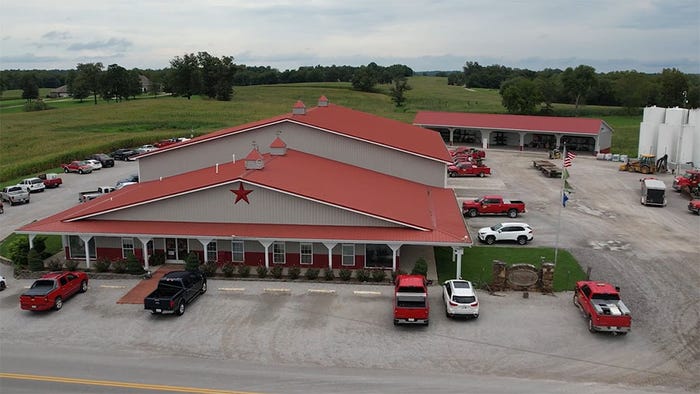
Know when to hold 'em Jan 1, 2005 12:00 PM by Bill Tindall In a raspy voice that draws in the listener, Kenny Rogers sings, “You've got to know when to hold 'em, know when to fold 'em.” In “The Gambler,” he laments about what most of us do every day — make dozens of decisions. Whether analyzing year-end records in the office, making customer calls, or giving fertilizer recommendations, the goal is to make more good decisions than bad. Every once in awhile in the life of an ag retailer, a big decision comes along. It is then that the years of day-to-day business decisions help guide him or her in deciding whether to “hold 'em, or fold 'em.” An example of such a decision is whether to construct a new plant or expand an existing one. Grow or go backwards In the early '80s, Dee Willard, owner of Willard Agri-Services, Frederick, MD, thought about expanding his business across the state line into the Delmarva Peninsula. He purchased an 80-acre farm south of Dover, DE. Shortly after that, he purchased a second fertilizer plant in Chestertown, DE, which put the idea of establishing a new plant on hold. However, more than 20 years later, Willard Agri-Services has completed construction of a state-of-the-art liquid fertilizer plant on the original land purchase. The philosophy of Bob Willard, current owner of Willard Agri-Services, is, “If a business isn't growing, it's going to go backwards. We built this plant so that we could make changes but wouldn't out-grow it for at least 10 years.” Working at Willard Agri-Services since the age of 17 and networking with others in the industry has helped Willard plan for expansion. He currently serves on the Ag Retailers Association Board of Directors and appreciates “the good friendships that have been established over the years.” During the company expansion, those friends served as strong and reliable sounding boards. “It is at industry meetings and conferences that I have been able to glean the best information on today's best technology,” Willard says. He believes in installing the best equipment to make his business more profitable over the long haul. He also believes that hiring the best people will make his business successful. Ken Fry, manager of the new plant, is an example of one of those people. A University of Maryland graduate with a degree in agronomy, over the years Fry further expanded his training in plant engineering. He was given the responsibility of managing construction and then plant operation as Willard Agri-Services expanded its business onto the land that Dee Willard had purchased 20-some years earlier. The site is ideally located on a major north-south highway in Delaware, with rail service onto the property. Custom engineering The plant was designed to mix and load 150 tons/hr. For dry handling equipment needs, Willard Agri-Services selected A.J. Sackett and Sons. Even though the company had used Sackett equipment before and was pleased with the performance, it didn't automatically buy that equipment again. Both Willard and Fry made use of their contacts and shopped around, comparing what other companies had to offer and what others in the industry had to say. “What finally sold us was Sackett's custom engineering. They were able to build their equipment to meet our needs so that we could off-load raw materials, either by trucks or railcars, into our buildings and mixers,” Fry says. The new plant has the capacity to hold 4,000 tons of dry fertilizer. Four bays can hold 800 to 1,200 tons each. From the storage bins, fertilizer is loaded into large Sackett hoppers, where two Sackett Bulk Toters transfer it to the mixer. From there, it is transferred into one of six load-out tanks in an enclosed building where trucks are filled from four load-out bays. Only one full-time person and one part-time person are needed to operate the plant, which is automated with a single control panel. The Device Net control system has only two buttons: one to start the system and an emergency stop button. Everything else operates from a touch screen. Cooperative expansion Eighteen-hundred miles across the country, in north-central Nebraska, a new cooperative named Central Valley Ag emerged out of three cooperatives: Central Farmers Co-op, Tri Valley Co-op, and Agland Co-op. The merger created one of the largest retail dry fertilizer plants in the Midwest. Ground for the new facility was broken, even before the merger, according to agronomist Gary Voichahoske. During a unification study, agronomy managers at the three cooperatives found that the co-op was short of dry fertilizer storage. As the managers at Willard Agri-Services did, they looked at their hand and decided expansion was the way to go. There was no barge traffic up the Missouri River to service the cooperatives. They also had aging facilities throughout their 26 locations. It became evident that the fertilizer distribution system was in the midst of major change, and to meet customer needs, the cooperatives had to expand. “The reason we chose to build in Monroe was that it was the only location with a rail line,” explains Voichahoske, fertilizer director for Central Valley Ag. Voichahoske and the other agronomists toured facilities in Minnesota, South Dakota and Iowa before deciding on a design. They chose Waconia Manufacturing. “We liked the tower system, which gave us greater tonnage capacity,” Voichahoske explains. Waconia had also recently installed three systems similar to what Central Valley Ag had in mind. Two main goals Immediately, they began construction of the new plant with two main goals in mind: It had to have plenty of storage, and they had to be able to get product to customers quickly during the short window of time for field application. The new facility had to be capable of by-passing dry plants and going directly to the fields. With a capacity of 43,000 tons and unloading capability of 800 tons/hr. from a railcar, Central Valley Ag didn't want any problems. Now, after a full season under their belts, the participants haven't been disappointed. “What Waconia said the equipment would do, it has done,” Voichahoske states. Taking the risk to expand seems to have been right for Central Valley Ag. It seems as though Kenny Rogers might have been singing just for Willard Agri-Services and Central Valley Ag when he said you've got to know what you're doing when you're a player in a high-stakes endeavor. |
|
||||||||||||||||||||||||||||||
| Back to Top |