![]() |
||||
|
|
||||
|
|
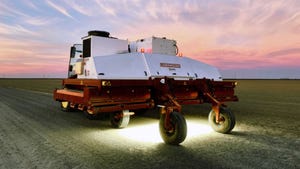
Light up your nights Jan 1, 2007 12:00 PM By Sarah Day Lighting on farm machinery is dramatically better than it was a decade ago, and three factors are pushing the switch. The first factor is the increase in farm size, requiring farmers to work more hours after dark to get their fieldwork done. “More farmers want to run around the clock,” says Brett DeVries, product manager specialist for AGCO Challenger combines. “So having good lighting at night is definitely key.” Another factor is the increase in the size of equipment, says Brian Arntson, product manager for John Deere large row-crop tractors. “As equipment has gotten larger, so has the need to see farther ahead and from side to side to keep an eye on today's large field implements,” he says. Finally, field speeds have gone up to around 5 to 7 mph, says Mitch Kaiser, Case IH product manager. “You need light to go further as speeds increase,” he says. Here's a closer look at the new lighting technologies, products and practices that are meeting farmers' needs. Light-emitting diode LEDs emit light from one to many tiny printed circuit board components. Because they don't have a filament, they won't burn out like ordinary incandescent bulbs. LED lights require minimal power consumption (typically only 1 to 3 watts), can withstand high vibration and are compact. High-density discharge lights To create HID light, a chamber is filled with xenon gas, which uses a small electric arch instead of a filament to create a more intense light. The light is up to two-and-a-half times brighter, while consuming 35% less power than a halogen bulb. An HID light also lasts up to five times longer than a halogen bulb. HID light is a whiter light, whereas halogen light is more yellow. Studies have shown that the more abundant and natural HID light on farm equipment reduces operator stress and fatigue. Because tractors and other agricultural vehicles run over uneven surfaces, a light source that can withstand large amounts of vibration is important. The xenon capsule does not contain a filament, so it will not come loose or burn out when subjected to extreme movement, unlike a filament that could become dislodged. Better placement Light placement is as important to good tractor lighting as brightness is, says Victoria McHugh, product manager of Hella Inc., a lighting manufacturer. “Lighting placement on the vehicle as well as the angle of inclination of the lamp are key components to optimal illumination of the work area and the elimination of dead spots,” she says. Beacon lights Case IH says farmers are asking for more beacon lights on their farm equipment so they can be more easily seen on the road as they travel from field to field. To meet that need, the company offers a flashing dual beacon light that can be mounted on any vehicle. Equipment manufacturers agree that customers have asked for a greater number of lights over the past five to 10 years. “The biggest change in lighting has been the number of factory-installed lights,” says New Holland's Falk. “Previously owners had to install their own lights to satisfy requirements.” Now manufacturers are providing a greater number of standard lights to meet customer demand for improved visibility. |
|
||||||||||||||||||||||||||||||||||
| Back to Top |