![]() |
||||
|
|
||||
|
|
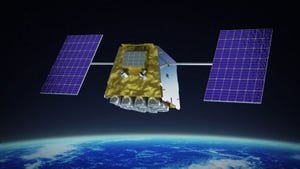
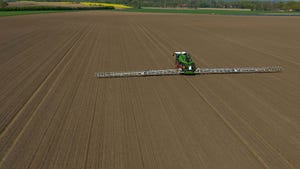
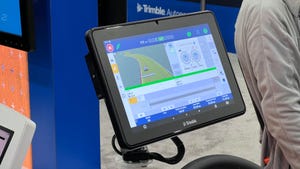
Online service tech Apr 1, 2007 12:00 PM By Jodie Wehrspann This spring Leica Geosystems will launch a new real-time kinematic (RTK) automated steering guidance system that can be serviced over the Internet. Like other RTK systems, the mojoRTK (short for “mobile job console”) uses a portable base station set up within four miles of a vehicle to correct for signal error caused by the orbital movement or “drift” of satellites. (Extended baselines of 10 and 16 miles will be available through authorized resellers.) But what sets it apart is a feature called the Virtual Wrench, which allows the system to be serviced and supported over a wireless cell phone link contained within the console. “Virtual Wrench is the first remote service and diagnostic tool available for autosteer guidance that provides for 24/7 online service and support,” says Trevor Mecham, head of Leica Geosystems' new North American Ag Division. “It allows for a Virtual Wrench technician to work on your system over the Internet to reduce service costs and eliminate the downtime in waiting for a service technician to get to your farm.” Virtual Wrench The system's console is small enough to fit into a cab's radio slot. A 900-megahertz radio inside the console allows a service technician to access the system over a wireless cell phone signal. Users can summon a technician simply by pushing a button on the console. “We are comparing this to the remote service and diagnostics systems being offered in some cars to unlock a car door, for example,” Mecham says. “With our system when the customer hits a button, a call is made to the Virtual Wrench technician alerting that service and support are needed.” The technician can view a screen showing the customer's name, serial number of the system and the type of service agreement. He or she then calls the user's cell phone, discusses the problem with the user, and asks permission to access the system. The technician can then diagnose and correct the problem all from his or her computer. Software downloads can be administered over the same wireless link. “No one has to come to your farm with a PCMCIA card or flash card,” Mecham says. “You can get the software wirelessly and remotely.” Two-inch accuracy The system is designed as a parallel tracking system to be used with an existing steering kit. Accuracy is 2 in. or less. “Other providers define RTK as sub-inch accuracy,” Mecham says. “But the real definition of RTK is real time kinematic, which means you are getting real-time information that accounts for drift using a fixed known location and that remains accurate with every pass.” Mecham says the system provides 2-in. accuracy 99% of the time from GPS correction signal and Glonass satellite availability, whereas most RTK sub-inch systems provide sub-inch accuracy only 55 to 60% of the time. The mojoRTK meets the ISO 11783 standard, which enables it to work with most third-party steering kits and many of the new factory-installed steering systems that reside on the tractor's CAN BUS and are electronically controlled. “A plug-and-play system that is electronically controlled is where the industry is headed so we can eliminate the bulky external hydraulic valve kits that growers have had to use,” Mecham says. “And we have built the mojoRTK with that in mind.” Leica Geosystems, which is known for the Leica camera and is a provider of machine automation and survey equipment, currently is testing mojoRTK in real-life farming situations. The company will market units on a limited run this spring and has scheduled full production for this summer. It has not yet released a price but says it will be extremely competitive. Online support will be provided through a service agreement. For more information, contact Leica Geosystems, 61 Inverness Dr. E., Suite 200, Englewood, CO 80112, 877/800-6656, www.mojoRTK.com. |
|
||||||||||||||||||||||||||||||||||||||||||||||||||||||||||
| Back to Top |