AmericanCowman.com: Timely, practical production and management strategies that will add efficiency, value, and profitability to cattle herds with up to 100 head.
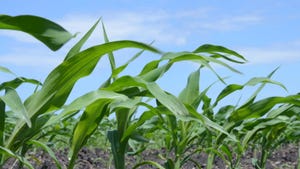
Dryland corn farmers looking for a way to protect water quality and optimize nitrogen (N) applications can now find help through a variety of commercial precision sensing technologies. However, much of the new equipment is still being perfected. Although it shows great promise, an economic payback isn't always guaranteed.
For example, three years of on-farm trials in Missouri that compared sidedress N applications to corn using a farmer's standard N rate to variable rates dictated by in-field sensors provided mixed results, says Ken Sudduth, USDA Agricultural Research Service (ARS) agricultural engineer, based in Columbia. The research trials were a collaborative effort by the USDA-ARS, the University of Missouri and MFA Incorporated. The researchers collected data from both NTech Industries' GreenSeeker optical sensors and Holland Scientific's Crop Circle Plant Canopy Sensor.
“In a general sense, both sensors performed similarly,” Sudduth says. “It appears that they were both varying N appropriately and would call for high N applications in the spots that looked more N stressed and low N applications in spots that looked less N stressed.”
Both in-field sensors did well in directing appropriate levels of N to the crop, agrees Peter Scharf, a University of Missouri nutrient management specialist. However, the profit levels achieved from using the equipment were a bit disappointing, he says.
“Overall, we lost 2.6 bu./acre of yield by using the sensors, compared to the producer rate, but we saved an average of 31 lbs. of N/acre,” he says. “Using period-average prices for both N and corn, we achieved about a $6.50/acre advantage from using the sensors, not counting application costs and technology costs. However, with the new recent increases in corn price and declines in N price, much of that advantage has now evaporated.”
Still, future technological advances and refinements could make the equipment work better in Missouri than it has so far, Scharf adds. In addition, state and federal environmental incentives or regulations also could increase the technology's value.
“Right now, the sensor technology isn't a big winner economically, but it's probably a winner on the environmental side,” he says. “In Missouri, the Environmental Quality Incentives Program (EQIP) is paying qualifying farmers $20/acre to do this. So if you have the EQIP payments, this gives you a pretty cost-effective way to prevent N from escaping from cornfields.”
Variable results
Corn growers in states with different soils might profit more from the sensor technology than corn growers in Missouri, Scharf says. “As you go farther north in the Corn Belt, there might be better opportunities for N savings than in Missouri, because of the higher organic matter soils that exist there,” he says. “There are more possibilities for N savings farther north than we have here.”
Yet further west and south, researchers at Oklahoma State University (OSU) have seen better economic results from using optical sensors to improve N management for corn than the Missouri researchers have. “Our on-farm research and demonstrations in wheat and corn have shown that a farmer can save at least $10 to $20/acre by using sensors to manage N applications, and the potential economic benefits would be more in corn than in wheat,” says Hailin Zhang, OSU soil scientist. “So the technology could pay for itself in one year's time, especially for a large-acreage farmer.”
OSU researchers originally developed their active precision sensing equipment to optimize N applications for wheat and then tried it in other crops, Zhang says. Eventually, NTech Industries Inc. bought the OSU patent and commercialized the GreenSeeker sensor.
“We started our research with winter wheat, but we have expanded it to corn, Bermuda grass and sorghum,” Zhang says. “This technique is expanding all over the world with many other crops, including rice.”
For now, relatively few Oklahoma farmers have bought the optical sensors, says Zhang, who reports that the cost to purchase a handheld sensor would approach $3,500. He adds, however, that crop consultants and county extension agents have been using the sensors for several years as a service to farmers.
“The sensors have also helped to prevent overfertilization,” Zhang says. “This year, we had a drought, and the sensor predicted that less N was needed in some fields.”
BREAKING NEWS
Low Foam Technology Syngenta announces that new Touchdown Total herbicide with Low Foam Technology reduces foaming during mixing and tank fill. Low Foam
BREAKING NEWS
New corn herbicide American Vanguard Corporation announces that its subsidiary, AMVAC Chemical Corporation, entered into an exclusive multiyear agreement
RR technology in H soybean varieties
Golden Harvest Seeds, Waterloo, NE, announces a soybean distribution agreement that will allow its customers a wide choice of genetics and Roundup Ready
Wireless grain
COMMODITY Resource Corporation (CRC) based in Caledonia, NY, is one of a growing number of operations that are working to bring bulk commodity handling
Compatible data for GPS/GIS
NEW SOFTWARE that allows automatic download of compatible data into major GPS/GIS software is now available from The Consulting Company of DeWitt, IA.
GreenSeeker goes red
GREENSEEKER technology will now be sold in the South and Midwest through Redball. The GreenSeeker technology that uses optical sensing for crop application
New radial technology
JUST WHEN you thought the radial bulge couldn't get any bigger, Michelin introduces its new Axiobib IF800/70R38 tire with technology. The tire is mounted
7 conclusions from a two-year study
Ohio researchers report seven conclusions from studies they conducted during 2005 and 2006 to evaluate various spray equipment for their potential to
CROPS
Arrow herbicide Makhteshim Agan of North America (MANA) introduces Arrow herbicide, the first generic clethodim, which can be used for eliminating the
PRODUCTS
New fertilizer grades Honeywell has launched two new grades of Sulf-N ammonium sulfate (21-0-0-24S) and improved quality specifications and supply for
Pollen blocker
HOEGEMEYER HYBRIDS, a regional seed company based in Hooper, NE, appears to have found a way to prevent cross contamination of pollen from genetically
Stacks flood seed market
SEED COMPANIES recently announced the release of their new 2006 corn hybrids and soybean varieties. Technology traits continue to dominate the market,
Atrazine adjustments
FOR GROWERS concerned with using atrazine to control weeds on sensitive watersheds, management alternatives are plentiful, says Bill Johnson, Purdue University
Q&A
DAN TOWERY created Ag Conservation Solutions, an ag consulting business, in January 2005, after working 25 years with the USDA Natural Resources Conservation
New products from Garst
GARST SEED Company, based in Slater, IA, offers 31 new corn hybrids and 18 new soybean varieties for 2006. Nine of the new hybrids contain Agrisure traits,
Less chemistry, more biotechnology
BY NOW, it's no surprise to most agricultural retailers that few new herbicides are entering the corn and soybean marketplace. Because new product development
Highlights from Louisville farm show
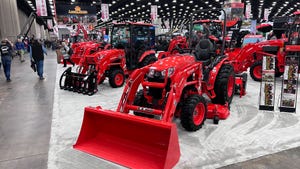
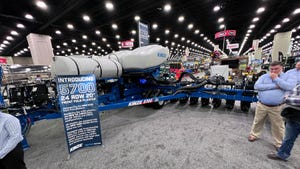
THE NATIONAL Farm Machinery Show held February 15-18 in Louisville, KY, had a record-setting attendance year, with more than 312,000 people visiting the
Interactive Web site
DOW AGROSCIENCES has developed an interactive Web site to help show corn growers how soil-applied herbicides can benefit corn weed-control systems. Visitors
Grain storage spillover
LIKE MANY grain-handling businesses, Buckingham Cooperative, near Waterloo, IA, needed to react quickly last year to find enough storage space to accommodate
Smart nitrogen advances
If David Hodges' experience with marketing Agrium's ESN (Environmentally Smart Nitrogen) fertilizer in 2006 is any indication, sales of the polymer-coated
The well-appointed Seed portfolio
Not Unlike clothing stores attuned to the latest fashions, ag retailers will be carrying certain must-have seed and seed accessories for spring 2007.
Climate change winners
If climate changes that are predicted as a result of global warming turn out to be true, the U.S. Corn Belt will be one of the winners in a world where
BT breakdowns
Corn growers may never find a method to control corn rootworms with 100% effectiveness. Even Bt rootworm hybrids sometimes stumble in their attempts
Questions about seed treatment
High-Rate Insecticidal seed treatments typically perform poorly where corn rootworm populations are plentiful, warn extension entomologists from several
Virtual terminal
THE NEW IntelliAg virtual terminal from Dickey-john is designed to interface with seed sensors, shaft monitors and hydraulic valves on planters, grain
Be your own weatherman
Dynasen For remote monitoring, Dynasen's custom-built Sens-Alert systems offer three choices: a radio-controller interface unit (RCIU), digital cell phone
Crop Sensor: Q & A
VIACHESLAV (SLAVA) Adamchuk is one of several U.S. land-grant researchers currently investigating innovative ways to use sensor technology for precision agriculture