AmericanCowman.com: Timely, practical production and management strategies that will add efficiency, value, and profitability to cattle herds with up to 100 head.


    Home  

    Market Research  

    For Advertisers  

    Rent Our Lists  

    About Us/Contact Us  

2005 Corn Weed Control Guide

Weeds (select up to 3)


Application Time

Sponsored by
Syngenta Crop Protection


2005 Soybean Weed Control Guide

Weeds (select up to 4)


Application Time

Sponsored by
UPI


         Subscribe in NewsGator Online   Subscribe in Bloglines

8 ways to reduce atrazine runoff

Apr 1, 2006 12:00 PM
John Pocock


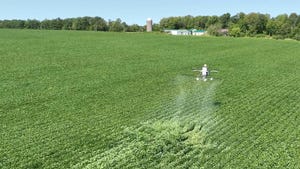
ANOTHER CROP season means another season of atrazine application. Farmers and custom applicators need to take steps to protect sensitive watersheds from atrazine runoff or risk losing the right to use the popular weed-control chemical.

Bill Johnson, Purdue University Extension weed scientist, says taking simple precautions will help cut atrazine runoff. Small watersheds located close to surface waters tend to have the most problems with atrazine runoff, he says. Runoff also tends to occur in areas that have clay-pan soils or soils that are unreceptive to water infiltration.

Johnson gives the following eight tips for reducing atrazine runoff from these areas:

  1. Choose a postemergence rather than a soil-applied product. Although the window of application is narrow, atrazine rates are cut 30 to 75% if application is delayed until weeds emerge. Then the herbicide is placed directly on the weed foliage.

  2. Avoid applications on saturated soils just before heavy rains to prevent loss of atrazine.

  3. Incorporate applications lightly if soil-applied because atrazine moves in solution with water and not by attaching to soil particles.

  4. Avoid applications near tile inlets, unless you incorporate or maintain at least 30% crop residue cover.

  5. Use tiling in your fields to reduce runoff. Tiles encourage water and atrazine infiltration into the soil where the atrazine can be absorbed into plant roots.

  6. Establish grass buffer strips along water bodies and ditches to help filter atrazine from water flowing across fields.

  7. Use tankmix products that provide good weed control with a reduced atrazine content. Purdue found that a low-rate atrazine premix that is tankmixed with another broadleaf herbicide reduced atrazine applied by 30 to 50% without hurting weed control.

  8. Read and follow directions on atrazine herbicide product labels.

Purdue University recently produced a best-management publication titled “Atrazine Use and Weed Management Strategies to Protect Surface Water Quality,” which discusses ways to reduce the amount of atrazine and other crop protection products that find their way into water sources. The publication is available online at btny.purdue.edu/Pubs/PPP/PPP-67.pdf.


SEFP ATE


Related Stories

Atrazine adjustments
FOR GROWERS concerned with using atrazine to control weeds on sensitive watersheds, management alternatives are plentiful, says Bill Johnson, Purdue University


Shifting loyalties
I like orange juice in the morning as part of my breakfast ritual. What made me think about that was a study done at the University of California Berkeley


Hybrids for high-temp drying
RESEARCHERS AT the University of Illinois have found that different hybrids handle drying at high temperatures better than others. The researchers found


Low impact?
U.S. SOYBEAN producers, bombarded almost daily with reports of new discoveries of Asian soybean rust, may be wondering at what point new findings of the


Droplet size control
CONTROL OF spray droplet size is critical for minimizing the risk of drift, says Scott Bretthauer, University of Illinois Extension specialist in application


Aphid-resistant soybeans
PIONEER HI-BRED International is analyzing its soybean varieties for resistance to soybean aphid. The company has screened numerous soybean lines with


Court good customers
WHAT'S THE best way to keep good customers coming back and to attract new ones? Fix annoying problems The first step is to focus on frustrations, says


Listen up
JUST HEARING the words of a speaker does not make for a good listener. Real listening the kind that brings results, solves problems and clarifies the


Optimal application
NOT EVERY expert agrees on how best to boost a sprayer's effectiveness, but few would disagree that the ultimate objective of a crop protection application


The adjuvant advantage
MORE THAN 4,000 adjuvants are on the market today to help improve a herbicide's performance. Bryan Young, associate professor of weed science at Southern


Scout for western bean cutworm
WESTERN BEAN cutworms (WBCs) have been a problem in the western Corn Belt since the 1940s and last year were discovered to have migrated further east


Stay ahead of your customers
WITH THE fast pace of change nowadays, identifying your customers' needs may seem like trying to hit a target moving at the speed of a Japanese bullet


The great (driverless) race
IT TOOK two tries over two years and a doubling of the prize money from $1million to $2 million, but in October 2005, the DARPA Grand Challenge found


Too reliant on Roundup?
RYEGRASS AND marestail were the first two weeds to develop resistance to glyphosate, such as Roundup and Touchdown herbicides, but they won't likely be


GreenSeeker goes red
GREENSEEKER technology will now be sold in the South and Midwest through Redball. The GreenSeeker technology that uses optical sensing for crop application


Price predictions
THIS GROWING season there is good news about nitrogen fertilizer: It appears that prices for the fertilizer will fall in late spring and early summer


The Phosphorus Index
NEW EPA and USDA efforts to improve surface water quality throughout the nation emphasize keeping a close eye on phosphorus (P), says Antonio Mallarino,


Crop Sensor: Q & A
VIACHESLAV (SLAVA) Adamchuk is one of several U.S. land-grant researchers currently investigating innovative ways to use sensor technology for precision agriculture


Double-crossed
CORN MIGHT not be the only hybrid farmers find in their fields. While corn breeders have been making strides since they first hybridized corn in the '30s,


Old habits die hard
YOUR GROWERS' crop rotation has most likely changed over the years, but their lime applications may not reflect that change. Some Midwestern researchers


Environmental protectors
Agricultural businesses and individuals must project a positive image by promoting environmental stewardship of the crop protection industry to receive


Innovations at Agromek
Boom controller, seed monitor. LH Agro introduced its 75 Command Box at Agromek. The Command Box can command up to seven boom sections using pulse width


Ditch liner
PENDA Corporation claims its corrugated plastic water management system called SmartDitch will greatly reduce water seepage in unlined irrigation canals


Inoculant application system
PIONEER HI-BRED International says silage producers can save time and wear and tear on their choppers by using its patented Appli-Pro Super Low Volume


Double-span pivot
A NEW dual-span irrigation pivot from Valmont Irrigation is helping growers in the West raise high-density crops such as carrots. Two sets of spans on


Precise ag chemical injection
CHEMILIZER says its new CP33 injector adjusts easily to a range of water volumes and helps to deliver chemicals quickly and accurately into the water


Friends of the environment
THE DECISION to invest in new storage and handling facilities in the last few years has reaped rewards for Eastern Farmers Co-op and Farmers Elevator


Soybean crop protection manufacturers
Advanced Biological Marketing America's Best Inoculant High Concentrate: Advanced Biological Marketing designed this 3.1-liter high concentrate inoculant


BREAKING NEWS
Low Foam Technology Syngenta announces that new Touchdown Total herbicide with Low Foam Technology reduces foaming during mixing and tank fill. Low Foam


BREAKING NEWS
New corn herbicide American Vanguard Corporation announces that its subsidiary, AMVAC Chemical Corporation, entered into an exclusive multiyear agreement


New grass herbicide
SYNGENTA Crop Protection anticipates that its new postemergence grass herbicide Axial will be approved for U.S. and Canadian registration and sale later


Less chemistry, more biotechnology
BY NOW, it's no surprise to most agricultural retailers that few new herbicides are entering the corn and soybean marketplace. Because new product development


New weapon in herbicide arsenal
THE INTRODUCTION of a new herbicide that can be used on rangeland, pastures, wildlife habitat areas and other non-cropland areas has sparked the interest

 
Back to Top


Key:    Paid Content      Enhanced for the Web

Contact Us  For Advertisers  For Search Partners  Privacy Policy  Subscribe
© 2007 Penton Media, Inc. All rights reserved.